
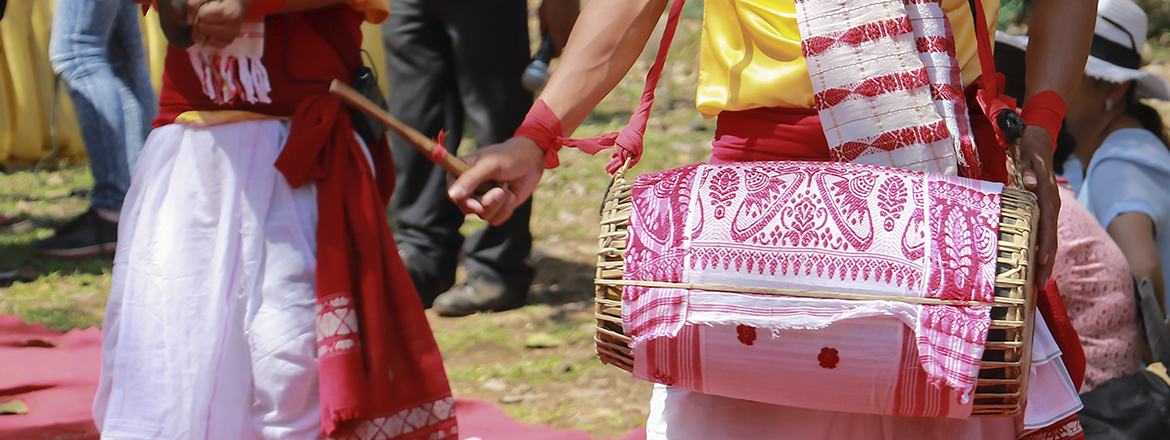
Deep in the forests of India, under a canopy of sal and teak that feels old enough to keep secrets, the beat of the mandar drum rises to signal that the sacred is close at hand. This is Madai, the season when the gods leave their shrines to visit one another, and the forest villages gather to give thanks for the harvest, strengthen family ties and hold on to a tribal way of life that has outlasted everything thrown at it.
Madai takes its time. Most religious events come and go in a day, but this one runs for months. From December to March it moves from one settlement to the next through the districts of Bastar, Kanker, Narayanpur and Dantewada in Chhattisgarh, and the quiet forest hamlets come alive with colour, faith and trade. The festival is always on the move, taking its drums and its dancing with it as the cool months pass. Each village waits its turn, and hosting is treated as an honour worth preparing for well ahead of time, so the whole region falls into the rhythm of the season together.
When the Gods Go Visiting
Everything about Madai comes back to the idea of the gods coming together. Within Gond tradition the deities of each village are imagined not as remote, distant powers but as neighbours of a kind, spirits woven into daily life who take as much pleasure in a friendly call as any villager might.
Approached in that spirit, the festival reads almost as a family reunion, only the relatives happen to be gods. A region’s chief deity, usually the honoured goddess Danteshwari, regarded as a form of Shakti, or else Kesharpal Kesharpalin Devi, plays host and summons the humbler deities from the villages round about. They come with all the warmth of kin who have not met in months.
Guests like these do not arrive quietly. Some ride on ‘Anga’, carved wooden litters passed down through generations, while others take the form of tall bamboo staffs called ‘Dang’, wrapped in bright red and gold cloth and topped with peacock feathers that sway overhead. Lifted high on the shoulders of their bearers, each one turns the walk towards the Madai ground into a small parade of its own.
One of the strongest beliefs here is that a deity, at the height of the celebration, takes possession of whoever shoulders its Anga. Often the bearer slips into a trance, lurching and swaying more freely as the drumming builds. What the crowd witnesses, so the tradition insists, is the god itself made flesh for a moment, rejoicing openly at the reunion with its own divine kin. Up close, the ordinary distance between people and gods seems to narrow almost to nothing.
Sacred Trees and a Human Bridge
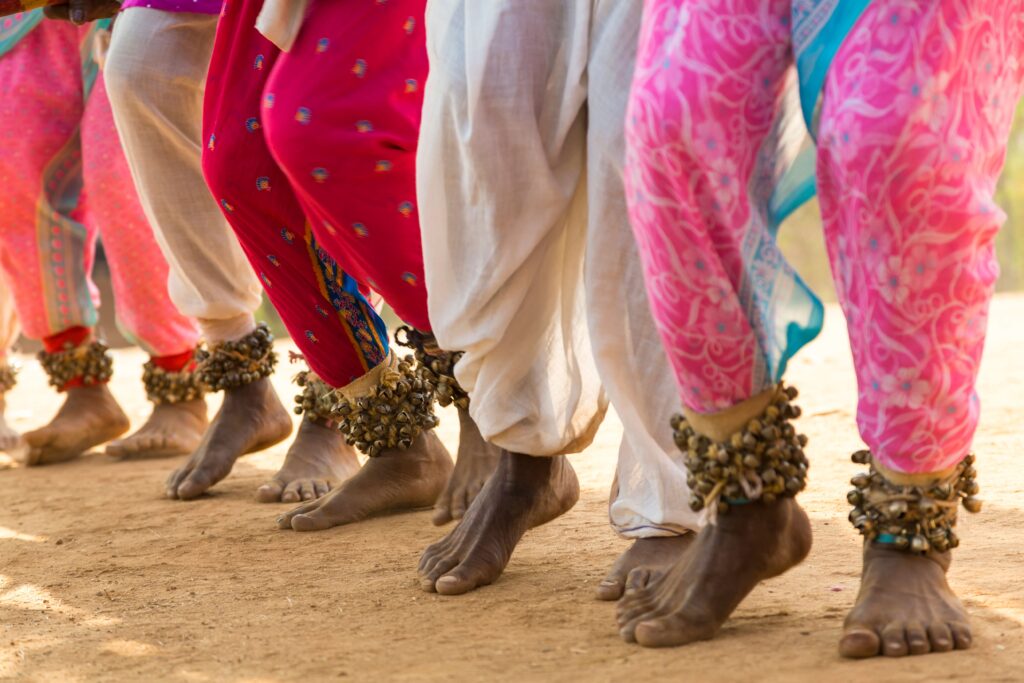
Madai usually starts in Bastar and works its way north, and it blends the worship of nature spirits with reverence for the goddess so closely that the two are hard to tell apart. The celebrations open on a broad clearing, known as the Madai ground, ideally within reach of flowing water. A living tree sits at the centre of the rites, honoured as a home of the spirits, and a goat is often sacrificed to appease the forest powers and bring good fortune to the year ahead.
These opening ceremonies build towards the great procession of the gods. The villagers carry their Anga and Dang round and round the sacred field in a swirling, high-spirited march, until the whole scene turns into a shifting mosaic of tilting bamboo, trailing cloth and flashing feathers. Between the noise, the constant movement and the tight press of bodies, the spectacle stays with everyone who sees it.
The Human Bridge of Dhamtari, preserved in one regional form of the celebration, is the most striking rite of all. Married women hoping for a child lie face down on the ground in a single row, and the priests and ritual healers known as ‘Baigas’ walk the length of those backs on the way into the shrine. This, so it is believed, grants the women the motherhood they have prayed for. Strange as it looks from the outside, the custom shows just how completely these communities put their trust in the goddess and in the men who act in her name.
The Colours of the Forest
The first thing to catch the eye at Madai is the drama of the dress, because among these tribes it is far more than something to cover the body. It is a proud statement of who a person is, and every fellow tribesman can read it. The Bison Horn Maria are best known for their dancing costume, the men crowned with a heavy headdress built from the horns of wild bison and trimmed with cowrie shells and peacock feathers, until it rises like something grown out of the forest itself.
A veil of cowries often falls across the face, giving every movement of the dance a touch of mystery. The women match this with bright knee-length saris, mostly in red and yellow, cut in the unmistakable style of their people. The overall effect is a rush of colour and movement against the green all around.
Silver finishes the picture, worn in abundance. Thick neck-rings called ‘Suta’ sit heavy at the collarbone, along with strings of coins and ornaments running round wrist and upper arm. Tattoos count for just as much, valued as protection for the spirit as well as a mark of beauty, their angular patterns tracing lines down arm and leg. Costume, silver and tattoos together turn each dancer into a moving emblem of the tribe.
A Taste of the Wild
Food at Madai is a straight tribute to what the forest gives, built far more on foraging and hunting than on anything bought at a stall. The boldest dish of the lot is ‘Chapda’, a chutney made from red ants.
The ants and their eggs are taken from the sal trees where they nest, then crushed and mixed with salt, fresh chilli and ginger. The taste is fiercely sharp and sour, the kind nobody forgets in a hurry, and among the forest people it has a reputation for keeping illness away. It is food and medicine at once, and a piece of heritage besides.
Beyond that one dish, no tribal feast is complete without ‘Mahua’, a strong liquor brewed from the fermented flowers of the mahua tree. Mahua does double duty, offered to the gods as something sacred and shared among the crowd to loosen tongues and warm the company. Alongside it comes ‘Landa’, a rice beer that keeps everyone going through days and nights given over entirely to the dance.
Meat, when there is any, comes mostly from the forest. The hunters bring back whatever game they have taken, and the chickens or goats offered in the rites are afterwards cooked over open fires as a tribal roast, with barely a spice, so that the smoke and the meat carry all the flavour.
The Cheul: One Fair, One Chance a Year
Madai is more than faith. It is also an economic lifeline. The festival ground turns into a sprawling fair, a ‘Mela’ known locally as the ‘Cheul’. For the many people scattered high in the hills for most of the year, this is the one occasion that brings them down to stock up on the basics they cannot do without, salt and oil, spices and cloth among them. Traders come in from well beyond the district, and for a short season the fair ties far-flung settlements back into a wider world, a rare chance to meet for people who might otherwise pass a whole year without seeing one another.
Buying and selling bring people in, but so does the entertainment. Cockfighting gathers some of the largest and loudest crowds of the festival, with big money changing hands and the men cheering the birds on. Even so, the true heartbeat of Madai is the dancing, which goes strong from dusk right through to dawn.
The Karma and the Relo bring men and women together, arms linked into long chains and slow-turning circles that show no sign of tiring. The drumming works its spell, carrying on without a break through the whole night until daylight edges over the treeline. Courtship runs alongside the celebration. Young people from different villages get to know one another across the beat of the drum, and time and again those meetings turn into a match settled before the festival is over.
Forest, God and Community
To call Madai simply a festival hardly does it justice. It endures as a refuge in which the Gond reaffirm who they are, honour the ancestors who came before them and pass on to the young a belief long held among them: that forest, god and community are not three things at all, but one and the same.